


Planning a construction project can be exciting, but it can also become complicated when you start working with measurements, materials, labor, and costs. Concrete is one of those materials where accuracy matters a lot. If you order too little, your project may come to a stop. If you order too much, you may end up paying for material that goes unused.
A concrete estimator can help solve this problem by giving you a clearer idea of how much concrete a project requires and, depending on the tool, how much the work could cost. From small home improvements to large commercial developments, concrete estimating plays an important role in keeping construction projects organized and financially manageable.
What Does a Concrete Estimator Do?
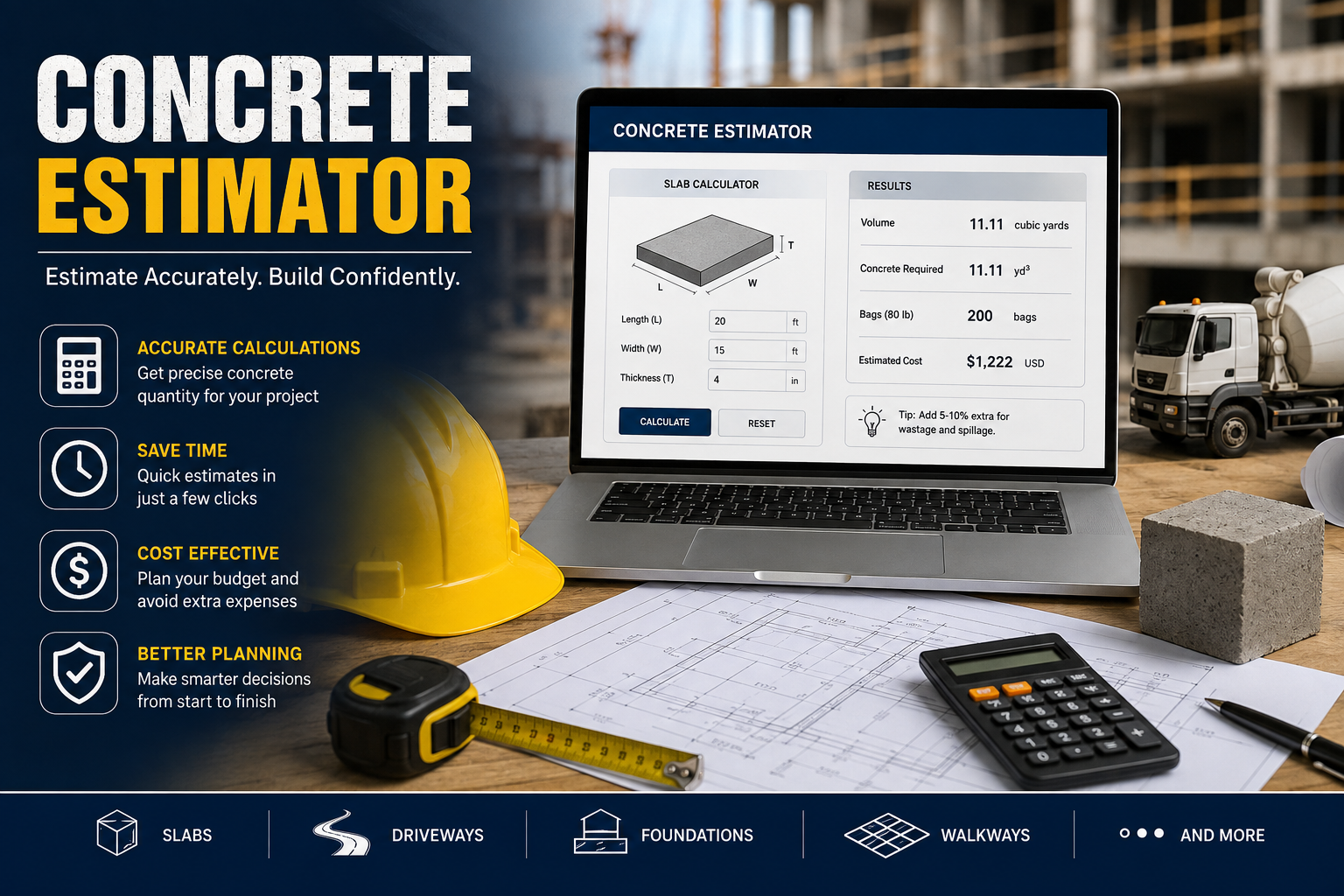
At its simplest, a concrete estimator calculates the amount of concrete needed for a particular area. It uses measurements such as length, width, and depth to determine the total volume.
For a standard rectangular slab, the calculation is straightforward. You multiply the length by the width and then multiply the result by the thickness. Once the volume is calculated, it can be converted into the measurement unit used by your concrete supplier.
However, construction projects are often more complicated than a basic rectangular slab. A driveway might have curves, a foundation can contain several sections, and footings may have different dimensions. More advanced estimating tools allow users to account for these variations.
Some professional estimating systems can also calculate additional project costs, including labor, materials, equipment, delivery, and other expenses.
Why Concrete Estimation Is Important
Concrete is usually purchased in specific quantities, so having an accurate estimate before placing an order is essential.
Imagine ordering concrete for a new driveway without measuring the area properly. If your calculations are too low, you could run out of concrete before the job is finished. That may mean arranging another delivery, waiting for the supplier, and potentially creating an unwanted break in the pour.
Ordering too much creates a different problem. Concrete has a limited working life, and unused material generally cannot simply be stored for another project.
Accurate estimation helps reduce both risks.
It also makes budgeting easier. Before construction starts, homeowners and contractors can have a better understanding of the likely material requirements and prepare accordingly.
How Concrete Quantity Is Calculated
The basic formula for calculating concrete volume is:
Length × Width × Thickness = Required Volume
The most important part is making sure all measurements use the same units.
For example, suppose you are preparing a slab that is 30 feet long and 15 feet wide. If the slab is 4 inches thick, the thickness must first be converted into feet before calculating the volume.
Once the volume has been determined, the result can be converted into cubic yards or cubic meters depending on the supplier’s measurement system.
While this calculation looks simple, manually calculating complicated projects can become time-consuming. A concrete estimator can automate much of this work and reduce the chance of basic mathematical mistakes.
Estimating Irregular Concrete Projects
Not every concrete project has four straight sides.
Consider a driveway with an unusual shape. You may need to divide the area into several smaller sections, calculate the volume of each section separately, and then add the results together.
The same approach may be necessary for:
- Foundations
- Footings
- Walkways
- Curved patios
- Concrete stairs
- Retaining structures
- Garage floors
- Commercial slabs
Using an estimating tool can make these calculations easier to organize. Instead of keeping several calculations on paper, the measurements can be recorded and reviewed in one place.
Understanding Concrete Costs
Calculating the quantity of concrete is only part of estimating a construction project. The final cost can depend on several other factors.
Material prices vary between suppliers and locations. Delivery distance can also affect the price, particularly when the project is far from the concrete plant.
Labor is another important consideration. A simple slab may require relatively straightforward preparation, while a complex foundation could require additional workers, reinforcement, excavation, and specialized equipment.
Other potential expenses include:
- Site preparation
- Excavation
- Reinforcement steel
- Formwork
- Concrete pumping
- Finishing
- Equipment rental
- Transportation
- Cleanup
A detailed estimate considers these factors rather than focusing only on the price of the concrete itself.
How Contractors Benefit From Estimating
For contractors, estimating is an important part of running a successful construction business.
Before accepting a project, a contractor needs to know whether the proposed price covers the expected costs and leaves enough room for profit. An inaccurate estimate can cause problems long after the contract has been signed.
A reliable concrete estimator can help contractors prepare bids faster and with greater consistency. It can also make it easier to compare different material options and adjust calculations when project specifications change.
For example, if a client decides to increase the thickness of a slab, the contractor can update the measurements and quickly see how the material requirements may change.
This flexibility is particularly useful when working on projects where plans are frequently revised.
How Homeowners Can Use a Concrete Estimator
Homeowners can also benefit from estimating tools, even if they plan to hire a professional contractor.
Suppose you want to install a concrete patio in your backyard. By measuring the proposed area, you can calculate an approximate concrete requirement before requesting quotes.
This information can help you understand contractor estimates and ask more informed questions.
It is important to remember, however, that a homeowner’s calculation should be treated as an estimate rather than a final construction specification. Professional contractors consider factors that may not be obvious to someone without construction experience.
Avoiding Common Estimating Mistakes
Several simple mistakes can affect concrete calculations.
One common problem is using incorrect measurements. Another is forgetting to convert inches into feet or centimeters into meters before calculating volume.
Some people also forget to account for the shape of the project. Treating an irregular area as a perfect rectangle can result in a significant difference between the estimated and actual quantities.
Another mistake is ignoring site conditions. Uneven ground, slopes, forms, and other construction details can affect the amount of concrete required.
Finally, it is important to avoid excessive waste allowances. A small buffer can be useful, but adding a large percentage unnecessarily can increase the project’s material costs.
Selecting an Estimating Tool
The right tool depends on the size and complexity of the project.
For a small residential project, a basic online calculator may provide everything you need. These tools are usually quick and easy to use.
Professional contractors may need more advanced estimating software that supports multiple project components, material pricing, labor calculations, and detailed quotations.
When selecting a concrete estimating solution, consider how easy it is to enter measurements, whether it supports different shapes, and whether it provides results in the units you normally use.
Conclusion
Accurate planning is one of the most important parts of any successful construction project. A concrete estimator makes the planning process easier by helping users calculate material quantities and, in more advanced systems, estimate the overall cost of concrete work.
For homeowners, it can provide a useful starting point when planning a new driveway, patio, walkway, or slab. For contractors, it can save time, improve project estimates, and reduce the risk of costly material mistakes.
Concrete may seem simple once it is poured and finished, but getting the right amount to the job site requires careful preparation. By measuring accurately, considering project conditions, checking current prices, and using a suitable estimating tool, you can approach your concrete project with greater confidence and fewer surprises.